

Neither framing tells you what testosterone actually does in a healthy man’s body, why it matters across a wider range of systems than most men realise, or why its gradual decline in midlife has effects that extend well beyond the bedroom. This article addresses that gap.
Testosterone is probably the most discussed hormone in men’s health, and one of the least understood. Most of what men know about it comes filtered through two extremes: the performance supplement world, which treats it as a source of strength and drive, and the clinical world, which focuses almost entirely on when levels are too low and what to do about it.
Where testosterone comes from
Testosterone is produced primarily in the testes, with a small contribution from the adrenal glands. Production is controlled by the hypothalamic-pituitary-gonadal axis: the hypothalamus releases gonadotropin-releasing hormone, which signals the pituitary gland to release luteinising hormone (LH) and follicle-stimulating hormone (FSH), which in turn stimulate the testes to produce testosterone. This is a feedback loop — when testosterone levels are sufficient, the axis damps down production; when they fall, the axis increases signalling.
Testosterone circulates in the blood in two main forms: bound to proteins (primarily sex hormone-binding globulin, or SHBG) and free. Free testosterone is the biologically active fraction — the portion available to act on tissues. Total testosterone is what most blood tests measure; free testosterone or calculated free testosterone is sometimes needed to complete the picture, particularly in men with elevated SHBG.
What it does in the body
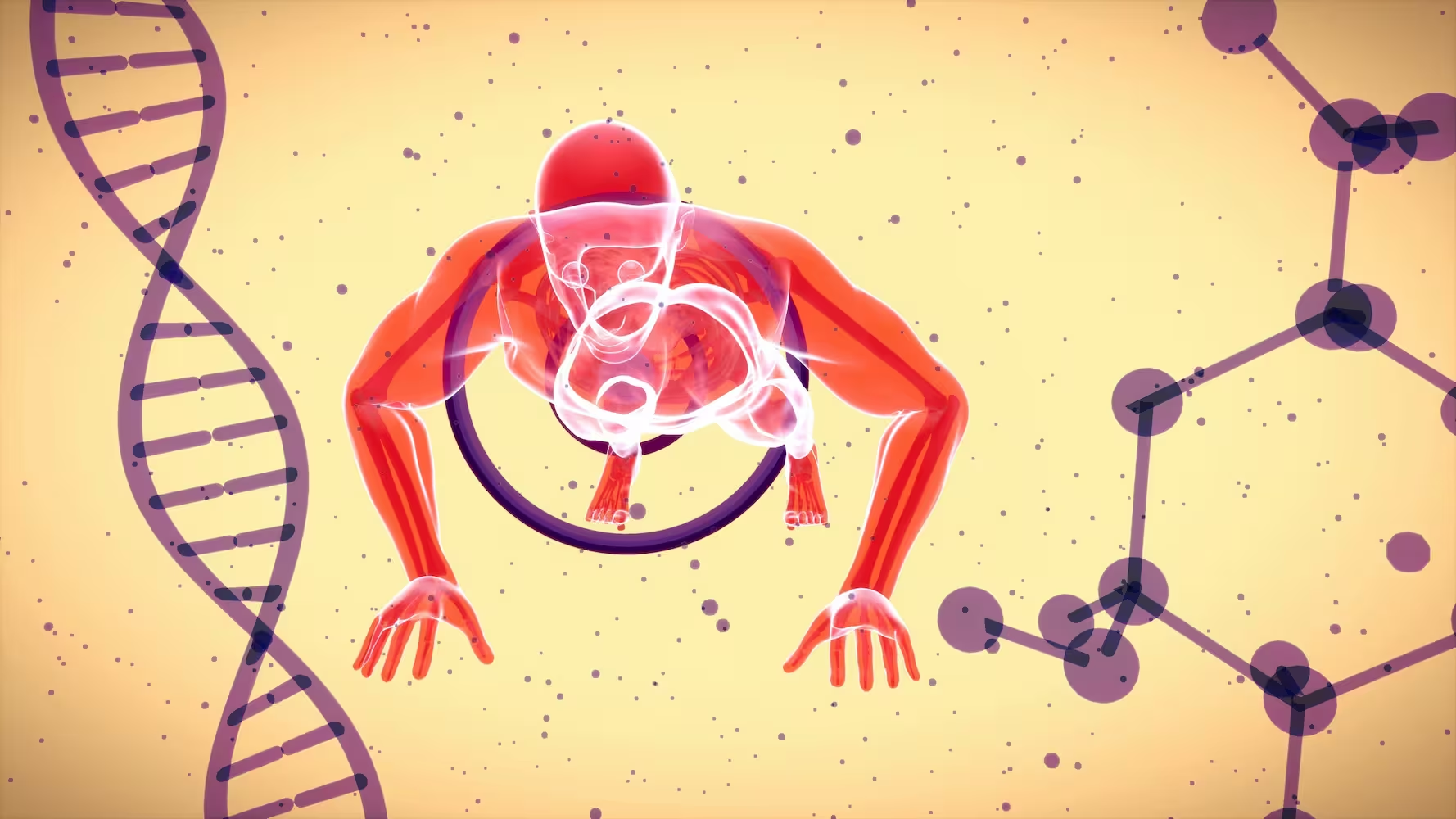
Testosterone acts on almost every tissue in the male body through androgen receptors. Its effects are broad and interconnected in ways that make a simple list inadequate — but the major functions fall into several categories.
Muscle mass and strength.
Testosterone promotes protein synthesis (anabolism) in muscle tissue and inhibits the catabolic processes that break muscle down. It is the primary hormonal driver of lean mass in men. This is why muscle loss is one of the earliest and most noticeable effects of declining testosterone, and why resistance training — which stimulates androgen receptors in muscle — is so closely linked to hormonal health.
Bone density.
Testosterone stimulates bone mineralisation and inhibits bone resorption. Men with chronically low testosterone lose bone mass at an accelerated rate, increasing fracture risk. The bone effects of testosterone are partly direct and partly mediated through oestradiol — testosterone is converted to oestradiol in bone tissue by the aromatase enzyme, and oestradiol plays a critical role in maintaining bone density in men as well as women.
Fat distribution.
Testosterone inhibits the differentiation of preadipocytes — precursor cells — into fat cells, particularly in visceral (abdominal) fat depots. As testosterone declines, the inhibitory effect weakens and visceral fat accumulates. Visceral fat is metabolically active in ways that subcutaneous fat is not: it drives insulin resistance, systemic inflammation, and further suppression of testosterone production through peripheral aromatisation. This creates a self-reinforcing cycle that is one of the more clinically significant consequences of midlife hormonal change in men.[1]
Sexual function.
Testosterone drives libido at the level of the central nervous system and supports erectile function through multiple pathways, including the maintenance of nitric oxide synthase activity in penile tissue. It is necessary for spermatogenesis — sperm production — and for maintaining testicular volume. Its effects on libido are dose-dependent within the normal range; below a certain threshold, libido typically declines meaningfully.
Mood, energy and cognitive function.
Androgen receptors are present throughout the brain, including in regions associated with mood regulation, motivation, and spatial cognition. Low testosterone is associated with fatigue, reduced motivation, low mood, and in some men, difficulties with concentration and memory. These are not simply the psychological consequences of feeling unwell — they reflect direct hormonal effects on the central nervous system, though the relationship is complex and varies considerably between individuals.
Red blood cell production.
Testosterone stimulates erythropoietin production in the kidney, which drives red blood cell synthesis. This is clinically relevant in two directions: low testosterone can contribute to mild anaemia, and testosterone replacement can raise haematocrit to levels that require monitoring.
Metabolic function.
Testosterone improves insulin sensitivity, supports glucose uptake in muscle tissue, and influences lipid metabolism. The association between low testosterone and metabolic syndrome — the cluster of visceral obesity, insulin resistance, dyslipidaemia, and hypertension — is bidirectional: metabolic syndrome suppresses testosterone, and low testosterone worsens metabolic function.[1]
When levels change
Testosterone levels peak in the late teens to mid-20s and decline gradually from the late 30s onward — at approximately 1–2% per year on average, though this varies considerably between men and is strongly influenced by modifiable factors including body weight, sleep quality, alcohol intake, and physical activity.[2]
The decline is gradual enough that many men do not notice a discrete change. What they notice instead is a cluster of shifts that accumulate over years: weight that settles differently, energy that is not what it was, muscle that is harder to maintain, sleep that is less restorative, libido that has quietly faded. These are not inevitable or untreatable, but they are unlikely to improve without addressing the underlying hormonal and metabolic picture.
Not all of these changes are caused by testosterone alone — other hormones, sleep architecture, metabolic health, and lifestyle factors all contribute. That is precisely why a proper assessment maps the whole picture rather than treating testosterone as an isolated variable.
The changes that accumulate quietly over years are worth investigating properly. Don’t simply attribute it to stress – consult a doctor about it.
What this means in practice
Understanding what testosterone does makes it easier to interpret symptoms that are often attributed to stress, ageing, or overwork. Fatigue, body composition change, reduced drive, and sexual changes in midlife are not always explained by any single factor — but testosterone is often part of the picture, and it is measurable.
If you have noticed changes in energy, body composition, mood or sexual function and wonder whether hormones are involved, the right next step is a proper assessment undertaken by a doctor.
- Muir CA, Wittert GA, Handelsman DJ. Approach to the patient: low testosterone concentrations in men with obesity. Journal of Clinical Endocrinology and Metabolism. 2025;110(9):e3125–e3130. doi:10.1210/clinem/dgaf137. PMID: 40052430.
- Wu FC, Tajar A, Pye SR, Silman AJ, Finn JD, O’Neill TW, Bartfai G, Casanueva F, Forti G, Giwercman A, Huhtaniemi IT, Kula K, Punab M, Boonen S, Vanderschueren D; European Male Aging Study Group. Hypothalamic-pituitary-testicular axis disruptions in older men are differentially linked to age and modifiable risk factors: the European Male Aging Study. Journal of Clinical Endocrinology and Metabolism. 2008;93(7):2737–2745. doi:10.1210/jc.2007-1972. PMID: 18270261.